


Manufacturing at the 2026 inflection point: How Frontier companies are entering the agentic era
With 2026 underway, manufacturing is reaching a clearer inflection point in how intelligence is defined and applied. Not long ago, the focus was on sensors, automation, and raw computing power. Today, the real story is orchestration—how companies connect fragmented data, processes, and people into an intelligent system that can sense, decide, and act across the research and development (R&D) lab, the shop floor, and the supply chain.
Manufacturing is moving beyond local optimization toward a closed loop of end-to-end intelligent orchestration. Looking back at CES 2026, we can see that the industry narrative is quiet but fundamentally shifting.
Across what we’re seeing with customers globally, three shifts stand out. First, the system shift. The operational foundation is evolving from digital to intelligent: more resilient, more real-time, and critically, more governable. Second, the data shift. The digital thread is no longer a static archive. It is becoming a living system—continuously updated and directly powering decisions as conditions change. Third, the work shift. We’re moving from copilots that assist individuals to agents that can collaborate and take on tasks—so the workflows themselves become more self-driving.
Together, these forces are raising the bar. Companies now need an end-to-end intelligent chain that turns AI from isolated point solutions into an organizational capability—reusable, scalable, and auditable. Drawing on Microsoft’s long-term work with manufacturers worldwide, and on how technology is evolving, I’d like to offer a practical framework for building that intelligent chain—so leaders can convert insight into action, and pilots into capabilities that scale.
AI use-case map for manufacturing: End-to-end intelligence from design to service
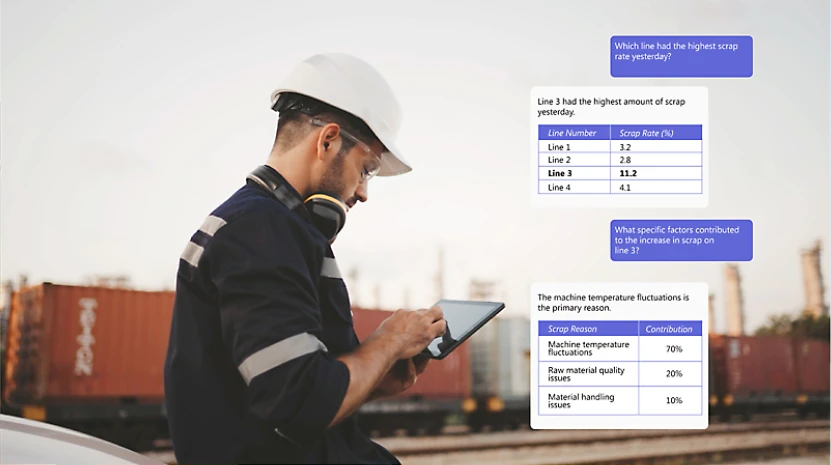
Scene One: Digital Engineering: Turning R&D into a profit engine
The role of the digital thread is evolving. Traditionally, it served primarily as a system of record—aggregating and archiving data. With AI and a unified data platform, it is becoming a real-time decision backbone spanning design, manufacturing, and service. Knowledge generated at one stage can now be applied immediately to improve outcomes in another. Generative and agentic AI are accelerating the core engineering loop—design, simulation, manufacturability analysis, and engineering change management—shortening iteration cycles and pushing risk discovery earlier in the process. Engineering data is no longer an R&D-only asset; it increasingly informs factory scheduling, quality strategies, maintenance policies, and service feedback loops.
This shift is already visible in practice. HARTING, a leader in industrial connectors, has deployed an AI assistant powered by Azure OpenAI and Microsoft Cloud for Manufacturing, making connector design faster, simpler, and more intuitive than ever before. Customers can describe their requirements in natural language, and the AI translates these inputs into technical specifications, guiding them to the right product within a minute. Customers can also visualize their configurations in 3D, enhancing confidence in their decisions. Siemens DI provides comprehensive cutting-edge software, hardware, and product lifecycle management solutions for industries including automotive and aerospace.
Using Microsoft Azure AI, Siemens DI developed a Microsoft Teams application for its industry-leading product lifecycle management (PLM) solution, Teamcenter. This solution analyzes unstructured voice content in multiple languages, automatically generates summary reports, and delivers information precisely to the relevant design, engineering, or manufacturing experts within Teamcenter. Through this intelligent collaboration mechanism, field issues are resolved faster, and knowledge transfer efficiency is significantly enhanced.
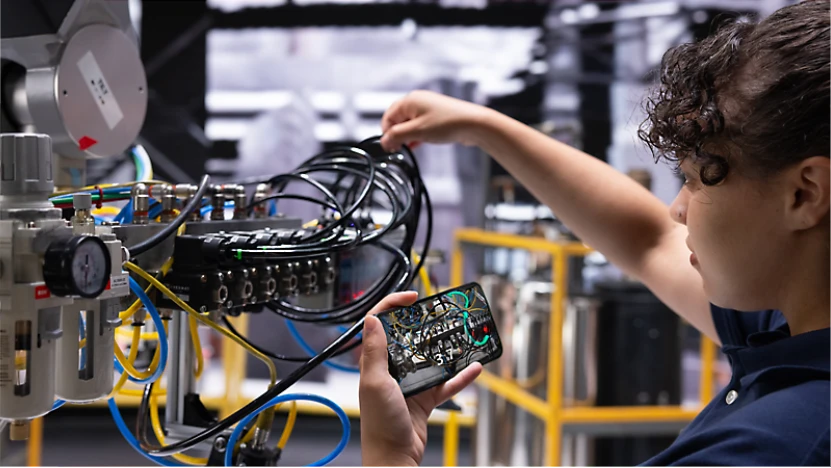
Scene Two: Intelligent Factory: AI is rewriting scheduling, quality, and maintenance
Production, maintenance, quality, and inventory remain the four core modules of factory operations—and that does not change in a smart‑factory context. What is changing is how these modules run. AI is systematically reshaping their operating logic: inventory management is moving from static rules to dynamic optimization based on real-time signals; quality management is shifting toward earlier, more precise judgments through computer vision, time‑series forecasting, and anomaly detection; and maintenance is evolving from after‑the‑fact repairs to predictive maintenance—progressing further toward adaptive process control.
As OT and IT capabilities mature, factories are gaining the ability to reason and respond directly at the point of value creation—on the shop floor, in real time. Frontline teams, empowered by multimodal Microsoft Copilot, can push the boundaries of what they can diagnose, decide, and execute. Over time, this human‑machine collaboration forms operational “agents” that can be deployed into production lines and day‑to‑day routines—turning intelligence into repeatable execution.
Global candy maker Mars operates manufacturing facilities across 124 locations worldwide. To safeguard its global equipment network, Mars partnered with Microsoft to deploy the Microsoft Defender for IoT solution. This enables visual management and threat detection for industrial equipment within stringent air-gapped production environments. Simultaneously, the solution transmits critical security data to a centralized system, enhancing data visibility while ensuring production continuity. International technology group Körber has transformed its market-leading PAS-X MES product into a cloud-based software as a service (SaaS) solution to address the stringent and multifaceted production management demands of the pharmaceutical sector. Using the robust stability of Microsoft Azure, Microsoft for Manufacturing, and Microsoft Azure Kubernetes Service, this solution enables customers to achieve greater flexibility and scalability. Simultaneously, by integrating data from IT and OT systems such as enterprise resource planning (ERP), supply chain management (SCM), and manufacturing execution system (MES), it delivers near real-time, actionable insights from diverse systems to employees. This significantly enhances equipment uptime, employee productivity, product quality, and overall output.
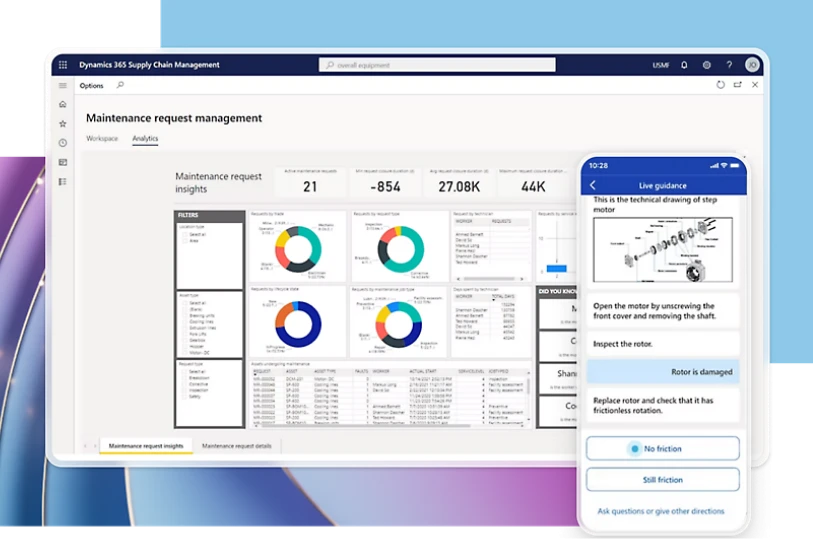
Scene Three: Resilient supply chain: From insight to execution with agentic AI
Early AI in supply chains mostly provided forecasts and dashboards. Valuable as they were, humans still needed to translate insights into action. The next step is agentic AI that executes—coordinating with suppliers, triggering replenishment or re-planning, optimizing inventory, and managing exceptions in logistics. When this happens, the traditional plan–execute–feedback loop transforms into a continuous intelligent system. The result is more than improved service levels—it enhances structural resilience and sustainability, as the system senses disruptions earlier, acts faster, and learns continuously.
A China-based electronics manufacturer, Xiaomi has built a unified after-sales supply chain management platform based on Microsoft Dynamics 365 and Microsoft Power Platform, using Azure for system integration and multilingual support. Utilizing Dynamics 365 Customer Service, Xiaomi has created a work platform that integrates financial processes, data integration, and security authentication across multiple communication channels. This platform also visualizes current inventory and proactively monitors and manages inventory levels in real time, enabling collaborative management between frontline services and backend supply chains. As a global leader in the smart terminal and home electronics industry, TCL is reshaping the industry landscape with its “Hardware + AI + Ecosystem” strategy, building a full-scenario ecosystem spanning multiple devices. Beyond driving innovative applications of Azure cloud and AI technologies in manufacturing, supply chains, and user experiences, TCL has pioneered the integration of Azure OpenAI, multimodal interaction, the intelligent Microsoft Copilot® assistant, and the Artificial Intelligence Generated Content (AIGC) ecosystem into smart TVs, smartphones, tablets, air conditioners, and other home appliances. This enables seamless cross-device connectivity and immersive experiences.
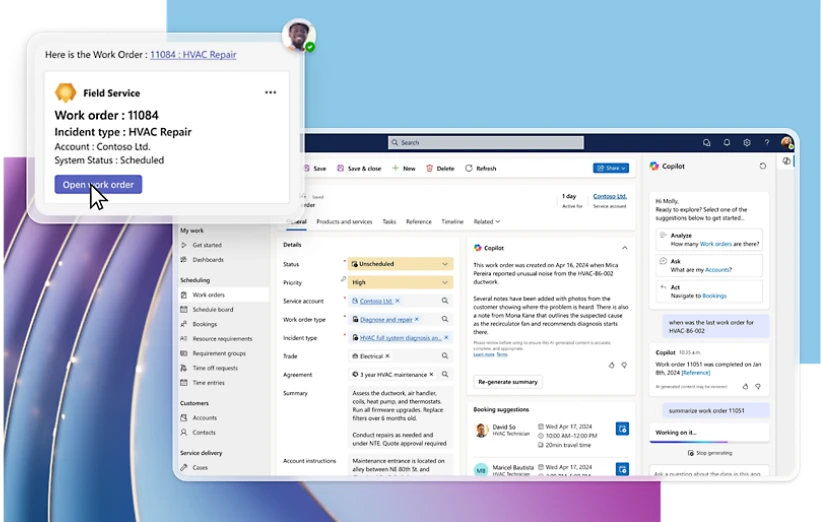
Scene Four: Connected customer: The product doesn’t end at delivery
In an AI-native model, product delivery is no longer the finish line. Customer experience continues through Over-the-Air (OTA) updates, AI-guided diagnostics, predictive service, and personal recommendations. AI enables a true closed loop—from customer feedback to engineering, factory, service, and back—turning experience into a growth driver rather than a cost center. None of this can scale without trust. As AI moves from recommendation to execution, governance becomes essential. Organizations need model governance, data and access control, OT and endpoint security, and explainability with rollback capabilities. This layer underpins all use cases, ensuring AI operates safely and reliably.
Epiroc, a Swedish mining and infrastructure equipment manufacturer, uses Microsoft Azure Machine Learning to build predictive maintenance and equipment performance models, transforming machine data into actionable customer insights. By identifying potential failures in advance and optimizing maintenance planning, Epiroc delivers a more proactive and transparent service experience, deepening customer relationships while opening new service-driven growth opportunities. Lenovo partnered with Microsoft to deploy the Microsoft Dynamics 365 Sales platform, thereby transforming its global customer relationship management (CRM) system.
By consolidating fragmented customer data and standardizing sales processes onto a unified digital platform, Lenovo achieved end-to-end visibility from lead management to opportunity tracking. The transformation improved collaboration efficiency, strengthened data-driven decision-making, and reinforced a more customer-centric operating model. In the “Hyper-Competition in High Dimensions” of the smart electric vehicle industry, NIO significantly boosts R&D efficiency by generating 610,000 lines of code daily through its intelligent GitHub Copilot® copilot, achieving an acceptance rate of up to 33%. The in-vehicle assistant NOMI, built on Azure OpenAI, enhances driving safety and user experience through precise contextual interaction. Simultaneously, Microsoft security solutions safeguard NIO’s complex IT environment and hybrid AI platform, automating daily threat detection and enabling cross-device security coordination.
Scene Five: Trust, safety, and OT security: The non-negotiable foundation
None of these AI use cases can scale without trust. Once AI moves from a recommendation system to an execution system, governance becomes essential. Manufacturing organizations need four core trust capabilities: model governance (ModelOps and Responsible AI), data and access control (Zero Trust architecture and industrial data protection,) OT and endpoint security, and explainability with controllability and rollback, so decisions can be understood, constrained, and safely reversed when needed. This is not a separate chapter; it forms the operating layer beneath all use cases, ensuring AI operates safely and reliably across the organization.
Ford, a longstanding automotive manufacturer synonymous with innovation, has deployed Microsoft solutions—including Microsoft Defender, Microsoft Sentinel, and Microsoft Purview—across its global operations. This initiative enhances visibility, automates responses, and strengthens data governance within its hybrid environment as companies worldwide face escalating cybersecurity threats. AI models learn from every interaction to improve detection capabilities and reduce false positives. With a unified security platform, Ford can focus on business strategy while reducing complexity and boosting operational efficiency. Smart pet device leader PETKIT is currently upgrading its systems on the Azure platform to achieve standardized device connectivity, telemetry data aggregation, and global compliance and security for users worldwide. Microsoft’s products and services not only enhance the company’s technological depth but also provide a cloud-plus-AI platform for global market replication.
2026: The inflection point when AI shifts from “more” to “different”
Once an end-to-end intelligent chain is in place, AI’s role inevitably shifts from offering advice to executing processes—and manufacturing moves from isolated efficiency gains toward full system redesign. In this sense, 2026 will be the year this transformation is proven on a scale. It will be a demanding moment for industry, but also a rare opportunity for leaders to make a true step change. This shift is becoming visible across several dimensions.
In 2026, AI in manufacturing will no longer exist as a collection of pilots. Instead, it will function as an enterprise nervous system—continuously sensing, learning, and coordinating decisions across functions. Organizations will move from experimenting with AI to running with AI, shifting from exploratory adoption to responsible, repeatable execution at scale.
Second, the ability to scale AI will become a key competitive differentiator. AI should not be confined to isolated applications but integrated into cross-departmental and cross-business collaboration to unlock its full potential. In other words, the gap between enterprises no longer lies in whether they deploy AI, but in their ability to achieve scalable implementation across the entire end-to-end value chain. Research from MIT and McKinsey suggests that leading enterprises can achieve up to four times the impact in half the time by building unified data and governance foundations.1
Third, technical readiness will help define 2026. Edge inference, OT and IT integration, industrial networking, and model governance have matured to the point where AI can operate directly where value is created—on the plant floor, in real time, and within the flow of work. AI is moving beyond general content generation toward deep operational integration, spanning equipment, processes, quality, and logistics, and becoming an integral part of closed-loop industrial control.
Beyond technology, people, governance, and culture will emerge as true differentiators. In 2026, the primary constraint for many manufacturers will be organizational readiness—the ability to share data responsibly, collaborate across silos, and build AI literacy and operating rhythms that sustain change. Research on scaling AI highlights the “10–20–70 rule”: roughly 10% of success comes from algorithms, 20% from technology and data foundations, and 70% from people and processes.1 Scaling AI effectively therefore requires building skills, accountability, and safety-and-governance capabilities in parallel with the technology itself.
Finally, the maturation of industry standards and ecosystems will accelerate broader AI adoption. Manufacturers face converging pressures—from geopolitics and cost to compliance and supply chain resilience. According to public records, 81% of manufacturers cite fear of falling behind as a primary driver of adoption.2 The implication is clear: the question is no longer “Do we need AI?” but “Can we afford not to evolve?” As industrial data semantics, standardized APIs, reference architectures, and increasingly packaged solutions mature, time-to-value will shorten and complexity will fall—making AI feasible for a much broader set of manufacturers.
From insight to action: A 2026 checklist for manufacturing leaders
At this point, the question is no longer abstract: can your organization turn AI capabilities into sustainable, day-to-day operations—rather than pilots and demos? In conversations with manufacturers around the world, this question consistently separates leaders from laggards:
- Strategic clarity: Have you defined the core business problems AI must solve, beyond simply “adopting AI”?
- Data foundation: Can your data platform support real deployment, not just proof-of-concept results?
- Operational readiness: Are your factories and supply chains prepared for AI-powered routines in daily execution?
- Workforce capability: Does your workforce have the baseline skills to work effectively with AI systems?
- Ecosystem usage: Do your partners and platforms support continuous upgrades and rapid scaling?
- Governance and security: Is governance strong enough for AI to move from recommendation to execution?
- Resilience impact: Is AI measurably strengthening operational resilience?
We can already see the direction of travel toward the future. But trends alone do not create leaders. Execution does. The real differentiator will be who can turn AI from concept into action, from tool into capability, and ultimately from capability into resilience.
Advancing intelligent manufacturing with Microsoft
Manufacturing is entering a new phase—powered by actionable data, increasingly autonomous systems, and a more empowered workforce. Companies that unify their data, drive autonomy across planning and execution, and integrate the value chain through digital threads and digital twins will be best positioned to convert operational excellence and innovation into sustained growth.
Against this backdrop, Microsoft continues to work closely with manufacturers to expand what is possible across design, production, supply chain, and service. By combining cloud, data, and AI platforms that are advanced yet practical to deploy, we aim to help organizations build end-to-end intelligent operations—accelerating innovation while maintaining security, responsibility, and scale.
1 KPMG, Intelligent manufacturing A blueprint for creating value through AI-driven transformation.