

Every major advancement in healthcare has expanded what people can achieve: giving people new ways to treat disease, helping organizations reach more people, and creating better conditions for discovery, service, and care. Medical breakthroughs transformed once-untreatable conditions. Digital health records made information more accessible. Digital tools helped healthcare organizations operate with greater scale and efficiency.
AI now represents the next step in that evolution, not because it simply introduces another technology, but because it can expand the capacity of people across the healthcare ecosystem.
Across healthcare and life sciences, organizations are moving beyond experimentation and embedding AI into everyday workflows. As they do, they are discovering that AI’s value extends beyond efficiency gains. It can help clinicians spend more time with patients, enable employees to make decisions faster, accelerate scientific discovery, and create new opportunities for innovation.
The shift is no longer theoretical. Providers, payors, life sciences organizations, and MedTech companies are already embracing new ways of working that combine human expertise with AI-powered capabilities, helping employees focus more of their time and energy on the work that matters most.
Helping clinicians spend more time where it matters most
Healthcare providers continue to face a persistent challenge: clinicians spend significant portions of their day on documentation and administrative tasks. For teams already navigating sustained burnout, these burdens compound daily pressure and take time away from meaningful patient interactions.
AI can help ease that burden by helping streamline documentation, improve access to information, and support workflows directly within the systems clinicians already use every day.
Intermountain Health uses Microsoft Dragon Copilot within its Epic electronic health record (EHR) workflow to capture patient-clinician conversations and automatically draft clinical notes. The organization has scaled adoption to more than 2,500 active Dragon Copilot users, helping reduce time spent on documentation and enabling more focused patient interactions.
By reducing administrative work, AI can help clinicians devote more attention to patient care, conversations, and clinical decision-making. In doing so, it creates more capacity for the expertise, empathy, and human connection that sit at the heart of healthcare.
Helping health plans deliver faster answers and better experiences
Payor organizations manage increasingly complex processes across claims, care management, compliance, provider engagement, and member services. Employees often need to navigate large volumes of information while responding to member needs quickly and accurately.
AI can help employees find information faster, surface relevant insights, and make more informed decisions—improving both operational efficiency and customer experiences.
Premera Blue Cross strengthened the digital foundation of its business by migrating Facets, its mission-critical payer administration platform, to Microsoft Azure. The migration was completed with zero data loss and no rollback required, improved batch processing by 38%, and created a more scalable, resilient foundation for future initiatives in claims, AI, and automation.
Expanding the capacity for scientific discovery
Healthcare and life sciences organizations generate enormous volumes of scientific knowledge and research data. Finding meaningful insights within that information has traditionally required significant time and effort.
AI is helping researchers analyze information more efficiently, uncover patterns across large datasets, explore emerging opportunities, and accelerate discovery.
Pierre Fabre built PLA.I.GROUND, a secure, contextualized, multi-model enterprise generative AI platform built on Microsoft Azure and Azure OpenAI. Today, more than half of the company’s office-based employees use PLA.I.GROUND daily to summarize documents, generate content, and accelerate code development, helping employees spend less time on low-value tasks and freeing time for innovation.
As AI becomes more deeply integrated into research workflows, organizations can amplify scientific expertise and create greater capacity to pursue the next breakthrough. When researchers spend less time searching, gathering, and synthesizing information, they gain more time to explore ideas, test hypotheses, and advance discovery.
Accelerating innovation across MedTech
MedTech organizations operate at the intersection of research, manufacturing, healthcare delivery, commercial operations, and regulatory requirements. Employees often need to access information from across the organization while collaborating with teams that span functions and geographies.
AI can help simplify this complexity by making it easier to retrieve information, summarize key discussions, create content, and collaborate more effectively.
KARL STORZ implemented Microsoft 365 Copilot for meeting summaries, drafting, and information retrieval. The organization achieved 97% active usage across approximately 2,000 licensed users, with 93% returning month over month.
These results demonstrate how AI can help organizations accelerate execution, improve collaboration, and empower employees to focus more of their time on innovation and strategic work. By reducing friction in everyday processes, AI enables teams to move from information to action more quickly and bring new ideas forward faster.
Innovation built on trust
As healthcare organizations expand the use of AI, trust remains essential.
Leaders must balance innovation with security, privacy, compliance, and responsible AI practices while ensuring employees feel confident using new technologies in their daily work. The organizations seeing the greatest success are treating trust not as a one-time initiative, but as an ongoing commitment that supports adoption and long-term value.
Ultimately, the value of AI in healthcare will not be measured by how quickly it is deployed, but by how confidently people can use it to make a difference. When innovation is grounded in trust, AI can empower the people delivering, supporting, and advancing care while protecting what matters most.
Put trusted AI to work
Trust is what turns AI adoption into durable value. The next question is where to apply it and how to move from a promising use case to measurable impact.
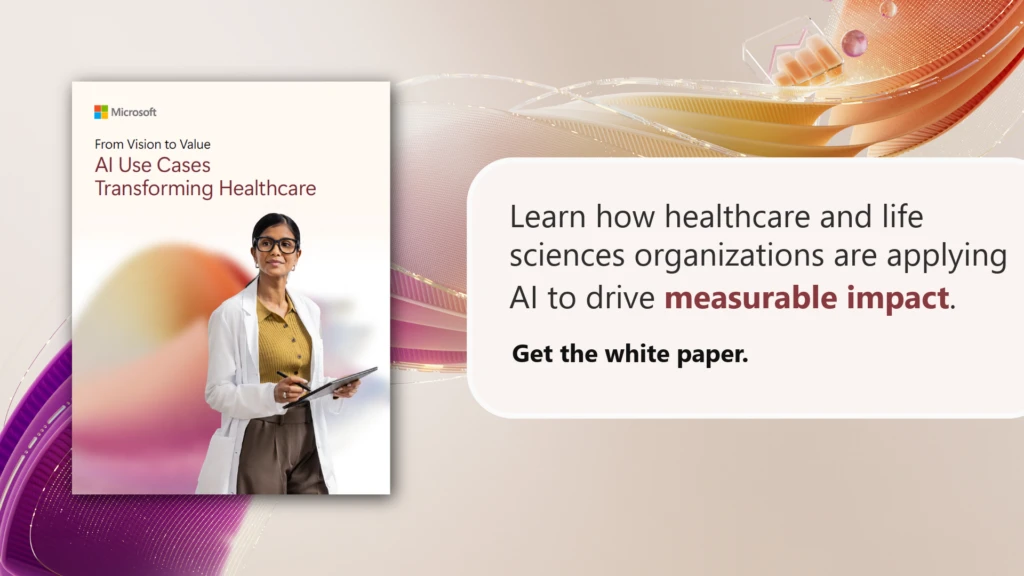
- Explore From Vision to Value: AI Use Cases Transforming Healthcare to learn how healthcare and life sciences organizations are applying AI today to drive measurable impact.
- Explore the AI in Action infographic for a concise look at how organizations are putting AI to work today and the outcomes they are achieving.
- Join Microsoft and healthcare leaders at MedTech Frontier AI Day during The MedTech Conference to examine what it takes to move from promising use cases to meaningful impact.
The next era of healthcare will be defined by how trusted AI expands the capacity to deliver care, advance discovery, and bring innovation to market.


