Research Focus: Week of May 7, 2025
In this issue: New research on compound AI systems and causal verification of the Confidential Consortium Framework; release of Phi-4-reasoning; enriching tabular data with semantic structure, and more.
GraphRAG helps advance AI use in complex domains like science. Thanks to enthusiastic adoption and community engagement, we’ve upgraded the pre-release version. Check out the major ergonomic and structural updates in GraphRAG 1.0.
Holistic motion-capture calibration technique without calibration, manual intervention or custom hardware; Research on AI agents for autonomous clouds; Automating proof-oriented program construction; One-to-many testing for natural language code generation.
Simplifying secure decision tree training; Improving accuracy of audio content detection; A novel neurosymbolic system for converting text to tables; New video series: AI for Business Transformation; TEE security protections for container workloads.
Advancing time series analysis with multi-granularity guided diffusion model; An algorithm-system co-design for fast, scalable MoE inference; What makes a search metric successful in large-scale settings; learning to solve PDEs without simulated data.
Unified databases offer better knowledge transfer between multimodal data types. They provide substantial corpus support for large language models and are poised to drive innovation in underlying hardware, laying the foundation for data-enhanced AI.
In this issue: RELEVANCE automatically evaluates creative LLM responses; Recyclable vitrimer-based printed circuit boards; Lean Attention: Hardware-aware scalable attention mechanism; WaveCoder: a fine-tuned code LLM; New AutoGen training course.
SIBYL is a machine learning model that makes highly accurate predictions of database queries, enabling tuning for more efficiency. Applying traditional database optimizations to these predicted queries helps maintain high performance as demands change.
LST-Bench is a new open-source benchmark designed to evaluate table formats in cloud environments. It extends existing benchmarks to better reflect real-world usage & performance of data lakes and easily integrates with commonly used analytical engines.
Welcome to Research Focus, a series of blog posts that highlights notable publications, events, code/datasets, new hires and other milestones from across the research community at Microsoft. Large language models (LLMs) have shown remarkable performance in generating text similar to that created by people, proving…
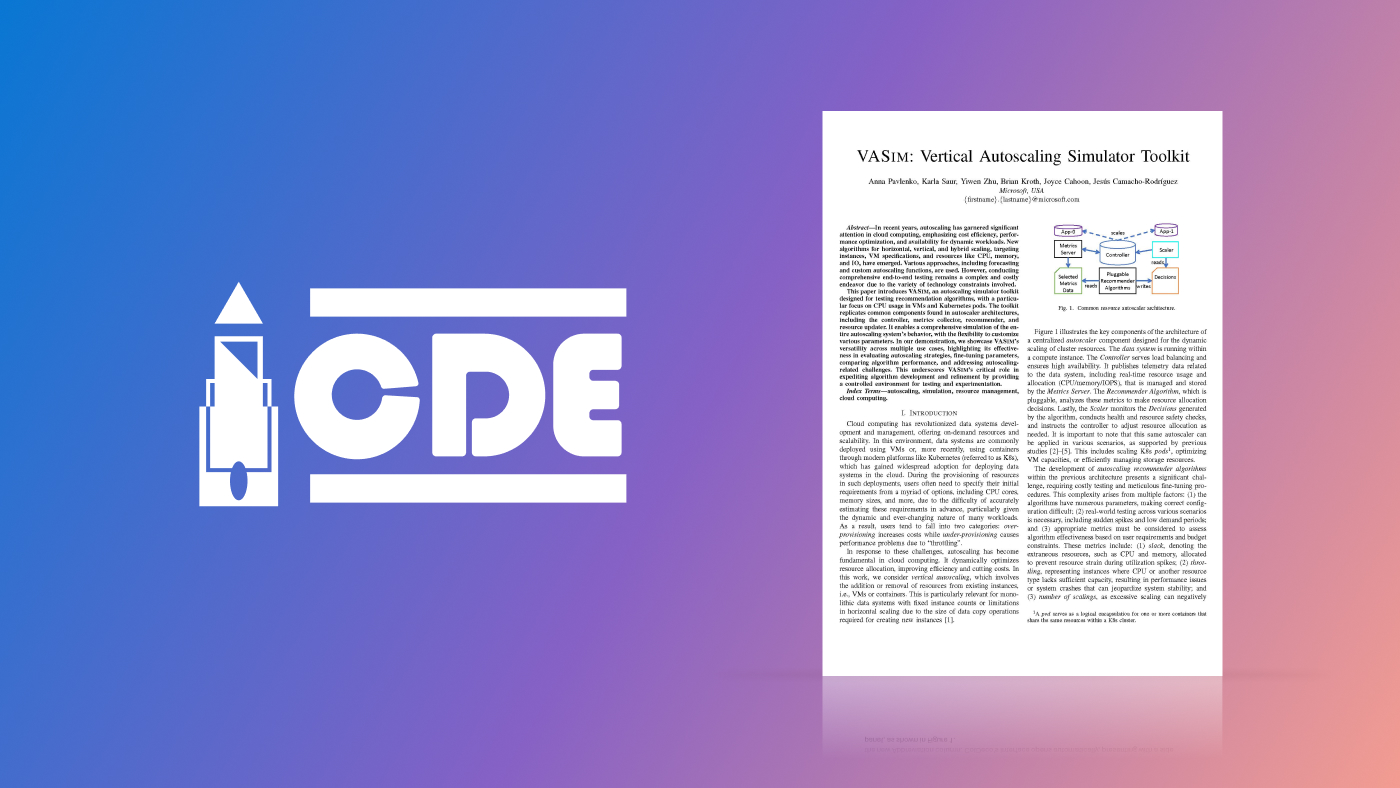
Autoscaling can optimize cloud resource usage and costs by adjusting to demand. VASIM shows that simplifying testing and refinement of autoscaling algorithms can enable rapid development and evaluation of more efficient & cost-effective autoscaling strategies.
Garnet is a cache-store system that addresses growing demand for data storage to support interactive web applications and services. Offering several advantages over legacy cache-stores, Garnet is now available as an open-source download.
Meet our community of researchers, learn about exciting research topics, and grow your network
Ongoing conversations at the cutting edge of research
Join us for a continuous exchange of ideas about research in the era of general AI