
Research Focus: Week of April 21, 2025
In this issue: our CHI 2025 & ICLR 2025 contributions, plus research on causal reasoning & LLMs; countering LLM jailbreak attacks; and how people use AI vs. AI-alone. Also, SVP of Microsoft Health Jim Weinstein talks rural healthcare innovation.
BiomedParse: A foundation model for smarter, all-in-one biomedical image analysis
| Hoifung Poon, Theodore Zhao, Yu (Aiden) Gu, Mu Wei, and Sheng Wang
BiomedParse reimagines medical image analysis, integrating advanced AI to capture complex insights across imaging types—a step forward for diagnostics and precision medicine.
Research Focus: Week of February 19, 2024
In this issue: CaaSPER: vertical autoscaling algorithm dynamically maintains optimal CPU utilization; Improved scene landmark detection for camera localization runs faster, uses less storage; ESUS simplifies usability questionnaires for technical products and services.
NeurIPS 2023 highlights breadth of Microsoft’s machine learning innovation
We’re proud to have 100+ accepted papers At NeurIPS 2023, plus 18 workshops. Several submissions were chosen as oral presentations and spotlight posters, reflecting groundbreaking concepts, methods, or applications. Here’s an overview of those submissions.
Frontiers of multimodal learning: A responsible AI approach
New evaluation methods and a commitment to continual improvement are musts if we’re to build multimodal AI systems that advance human goals. Learn about cutting-edge research into the responsible development and use of multimodal AI at Microsoft.
Research Focus: Week of November 7, 2022
Welcome to Research Focus, a new series of blog posts that highlights notable publications, events, code/datasets, new hires and other milestones from across the research community at Microsoft. Barun Patra, Saksham Singhal, Shaohan Huang, Zewen Chi, Li Dong, Furu Wei,…
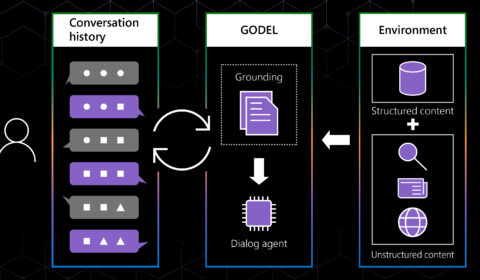
GODEL: Combining goal-oriented dialog with real-world conversations
| Baolin Peng, Michel Galley, Lars Liden, Chris Brockett, Zhou Yu, and Jianfeng Gao
They make restaurant recommendations, help us pay bills, and remind us of appointments. Many people have come to rely on virtual assistants and chatbots to perform a wide range of routine tasks. But what if a single dialog agent, the…
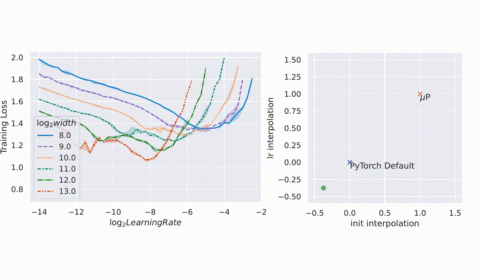
µTransfer: A technique for hyperparameter tuning of enormous neural networks
| Edward Hu, Greg Yang, and Jianfeng Gao
Great scientific achievements cannot be made by trial and error alone. Every launch in the space program is underpinned by centuries of fundamental research in aerodynamics, propulsion, and celestial bodies. In the same way, when it comes to building large-scale…

SOLOIST: Pairing transfer learning and machine teaching to advance task bots at scale
| Baolin Peng, Chunyuan Li, Jinchao Li, Lars Liden, and Jianfeng Gao
The increasing use of personal assistants and messaging applications has spurred interest in building task-oriented dialog systems (or task bots) that can communicate with users through natural language to accomplish a wide range of tasks, such as restaurant booking, weather…