
Ideas: Community building, machine learning, and the future of AI
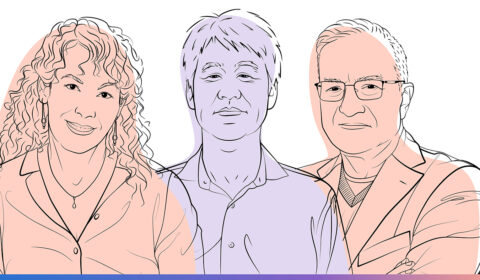
| Jenn Wortman Vaughan and Hanna Wallach
As the Women in Machine Learning Workshop (WiML) marks its 20th annual gathering, cofounders, friends, and collaborators Jenn Wortman Vaughan and Hanna Wallach reflect on WiML’s evolution, navigating the field of ML, and their work in responsible AI.

Ideas: More AI-resilient biosecurity with the Paraphrase Project
| Eric Horvitz, Bruce Wittmann, Tessa Alexanian, and James Diggans
Microsoft’s Eric Horvitz and guests Bruce Wittmann, Tessa Alexanian, and James Diggans discuss the Paraphrase Project—a red-teaming effort that exposed and secured a biosecurity vulnerability in AI-driven protein design. The work offers a model for addressing AI’s dual-use risks.
Coauthor roundtable: Reflecting on healthcare economics, biomedical research, and medical education
| Peter Lee, Carey Goldberg, and Dr. Isaac Kohane
For the series finale, Peter Lee, Carey Goldberg, and Dr. Zak Kohane compare their predictions to insights from the series’ most recent guests, including experts on AI’s economic and societal impact, leaders in AI-driven medicine, and doctors in training.

Reimagining healthcare delivery and public health with AI
| Peter Lee, Dr. Umair Shah, and Dr. Gianrico Farrugia
Former Washington State Secretary of Health Dr. Umair Shah and Mayo Clinic CEO Dr. Gianrico Farrugia explore how healthcare leaders are approaching AI when it comes to public health, care delivery, the healthcare-research connection, and the patient experience.

Navigating medical education in the era of generative AI
| Peter Lee, Dr. Morgan Cheatham, and Daniel Chen
Next-generation physicians Morgan Cheatham and Daniel Chen discuss how generative AI is transforming medical education, exploring how students and attending physicians integrate new tools while navigating questions on trust, training, and responsibility.

AI Testing and Evaluation: Reflections
| Kathleen Sullivan and Amanda Craig Deckard
In the series finale, Amanda Craig Deckard returns to examine what Microsoft has learned about testing as a governance tool. She also explores the roles of rigor, standardization, and interpretability in testing and what’s next for Microsoft’s AI governance work.

AI Testing and Evaluation: Learnings from cybersecurity
| Kathleen Sullivan, Ciaran Martin, and Tori Westerhoff
Drawing on his previous work as the UK’s cybersecurity chief, Professor Ciaran Martin explores differentiated standards and public-private partnerships in cybersecurity, and Microsoft’s Tori Westerhoff examines the insights through an AI red-teaming lens.

How AI will accelerate biomedical research and discovery
| Peter Lee, Daphne Koller, Noubar Afeyan, and Dr. Eric Topol
Daphne Koller, Noubar Afeyan, and Dr. Eric Topol, leaders in AI-driven medicine, discuss how AI is changing biomedical research and discovery, from accelerating drug target identification and biotech R&D to helping pursue the “holy grail” of a virtual cell.

AI Testing and Evaluation: Learnings from pharmaceuticals and medical devices
| Kathleen Sullivan, Daniel Carpenter, Timo Minssen, and Chad Atalla
Professors Daniel Carpenter and Timo Minssen explore evolving pharma and medical device regulation, including the role of clinical trials, while Microsoft applied scientist Chad Atalla shares where AI governance stakeholders might find inspiration in the fields.