

Microsoft Research
AI for Science
News & features
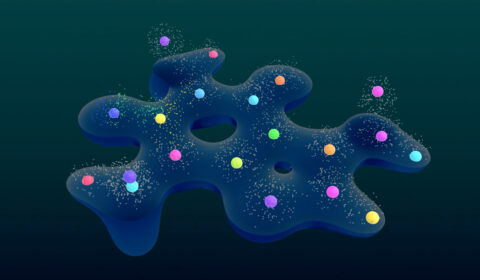
Breaking bonds, breaking ground: Advancing the accuracy of computational chemistry with deep learning
| Rianne van den Berg, Jan Hermann, Christopher Bishop, and Paola Gori Giorgi
Microsoft researchers achieved a breakthrough in the accuracy of DFT, a method for predicting the properties of molecules and materials, by using deep learning. This work can lead to better batteries, green fertilizers, precision drug discovery, and more.
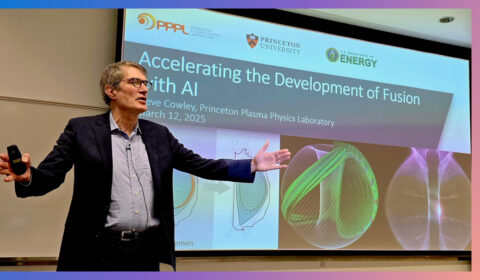
Microsoft Fusion Summit explores how AI can accelerate fusion research
| Kenji Takeda, Shruti Rajurkar, and Ade Famoti
The first Microsoft Research Fusion Summit brought together global experts to explore how AI can help unlock the potential of fusion energy. Discover how collaborations with leading institutions can help speed progress toward clean, scalable energy.
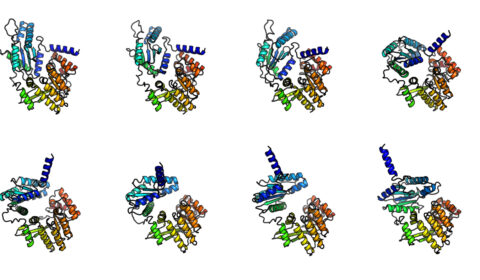
Exploring the structural changes driving protein function with BioEmu-1
| Sarah Lewis, Tim Hempel, Jose Jimenez-Luna, Michael Gastegger, Yu Xie, Victor García Satorras, Osama Abdin, Bas Veeling, Ryota Tomioka, and Frank Noé
Meet BioEmu-1 from Microsoft Research. This deep learning model can generate thousands of protein structures per hour, unlocking new possibilities for protein scientists and drug discovery and research.
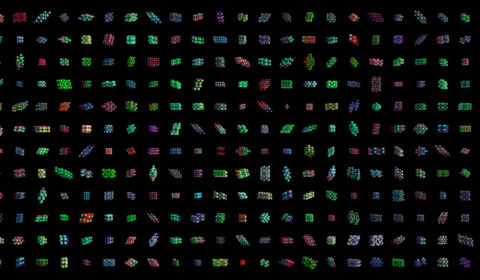
MatterGen: A new paradigm of materials design with generative AI
| Claudio Zeni, Robert Pinsler, Daniel Zügner, Andrew Fowler, Matthew Horton, Ryota Tomioka, and Tian Xie
Microsoft researchers introduce MatterGen, a model that can discover new materials tailored to specific needs—like efficient solar cells or CO2 recycling—advancing progress beyond trial-and-error experiments.
Research Focus: Week of December 16, 2024
NeoMem: hardware/software co-design for CXL-native memory tiering; Chimera: accurate retrosynthesis prediction by ensembling models with diverse inductive biases; GA4GH task execution API enables multicloud task execution.
Microsoft Research Forum Episode 4: The future of multimodal models, a new “small” language model, and other AI updates
Explore multimodal & small language models, plus advanced benchmarks for AI evaluation. Microsoft researchers are working on breakthroughs in weather prediction, materials design, even a new kind of computer for AI inference and hard optimization problems.
Research Focus: Week of July 15, 2024
Advancing time series analysis with multi-granularity guided diffusion model; An algorithm-system co-design for fast, scalable MoE inference; What makes a search metric successful in large-scale settings; learning to solve PDEs without simulated data.

Microsoft Research Forum Episode 3: Globally inclusive and equitable AI, new use cases for AI, and more
“We’re at the very early stage of generative AI and the impacts it will have on work. This is a fast-moving field, and there’s an immense opportunity to take control of the agenda and build truly globally equitable AI systems”,…
Introducing Aurora: The first large-scale foundation model of the atmosphere
| Wessel Bruinsma, Megan Stanley, Ana Lucic, Richard Turner, and Paris Perdikaris
Aurora, a new AI foundation model from Microsoft Research, can transform our ability to predict and mitigate extreme weather events and the effects of climate change by enabling faster and more accurate weather forecasts than ever before.