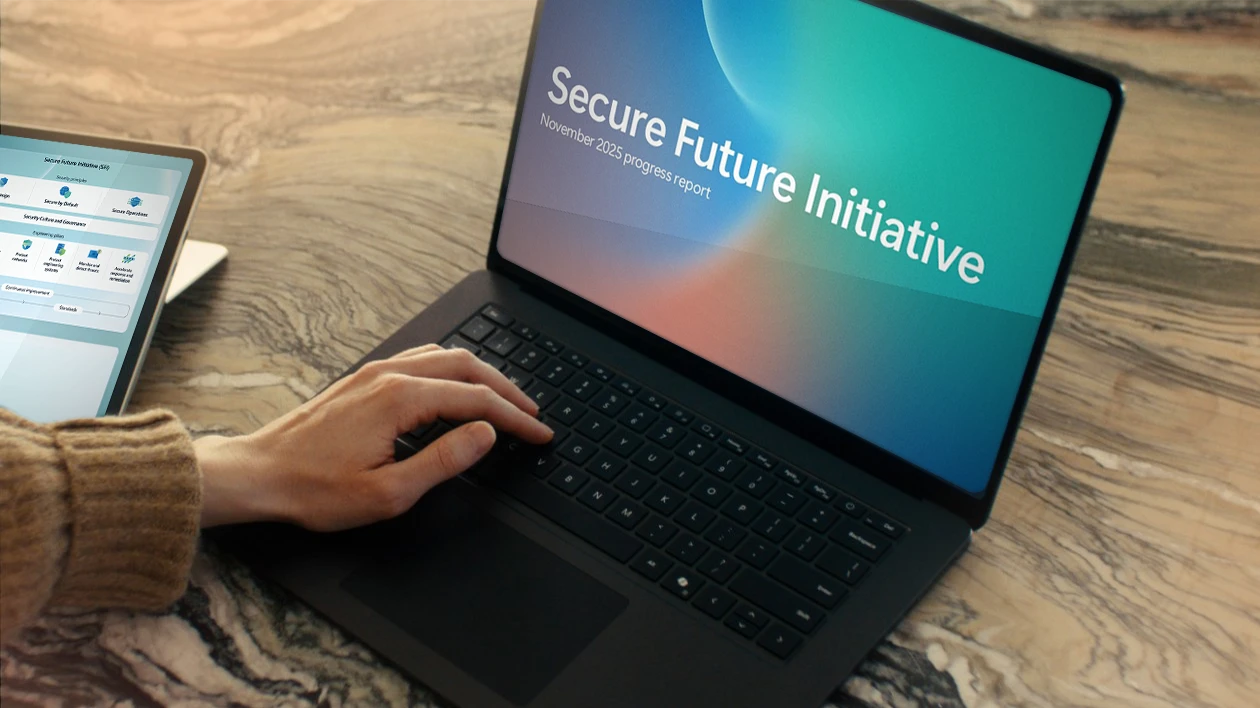
When we launched the Secure Future Initiative (SFI), our mission was clear: accelerate innovation, strengthen resilience, and lead the industry toward a safer digital future. Today, we’re sharing our latest progress report that reflects steady progress in every area and engineering pillar, underscoring our commitment to security above all else. We also highlight new innovations delivered to better protect customers, and share how we use some of those same capabilities to protect Microsoft. Through SFI, we have improved the security of our platforms and services and our ability to detect and respond to cyberthreats.
Fostering a security-first mindset
Engineering sentiment around security has improved by nine points since early 2024. To increase security awareness, 95% of employees have completed the latest training on guarding against AI-powered cyberattacks, which remains one of our highest-rated courses. Finally, we developed resources for employees and made them available to customers for the first time to improve security awareness.
Governance that scales globally
The Cybersecurity Governance Council now includes three additional Deputy Chief Information Security Officers (CISOs) functions covering European regulations, internal operations, and engagement with our ecosystem of partners and suppliers. We launched the Microsoft European Security Program to deepen partnerships and better inform European governments about the cyberthreat landscape and collaborating with industry partners to better align cybersecurity regulations, advance responsible state behavior in cyberspace, and build cybersecurity capacity through the Advancing Regional Cybersecurity Initiative in the global south. You can read more on our cybersecurity policy and diplomacy work.
Secure by Design, Secure by Default, Secure Operations
Microsoft Azure, Microsoft 365, Windows, Microsoft Surface, and Microsoft Security engineering teams continue to deliver innovations to better protect customers. Azure enforced secure defaults, expanded hardware-based trust, and updated security benchmarks to improve cloud security. Microsoft 365 introduced a dedicated AI Administrator role, and enhanced agent lifecycle governance and data security transparency to give organizations more control and visibility. Windows and Surface advanced Zero Trust principles with expanded passkeys, automatic recovery capabilities, and memory-safe improvements to firmware and drivers. Microsoft Security introduced data security posture management for AI and evolved Microsoft Sentinel into an AI-first platform with data lake, graph, and Model Context Protocol capabilities.
Engineering progress that sets the benchmark
We’re making steady progress across all engineering pillars. Key achievements include enforcing phishing-resistant multifactor authentication (MFA) for 99.6% of Microsoft employees and devices, migrating higher-risk users to locked-down Azure Virtual Desktop environments, completing network device inventory and lifecycle management, and achieving 99.5% detection and remediation of live secrets in code. We’ve also deployed more than 50 new detections across Microsoft infrastructure with applicable detections to be added to Microsoft Defender and awarded $17 million to promote responsible vulnerability disclosure.
Actionable guidance
To help customers improve their security, we highlight 10 SFI patterns and practices customers can follow to reduce their risk. We also share additional best practices and guidance throughout the report. Customers can do a deeper assessment of their security posture by using our Zero Trust Workshops which incorporate SFI-based assessments and actionable learnings to help customers on their own security journeys.
Security as the foundation of trust
Cybersecurity is no longer a feature—it’s the foundation of trust in a connected world.
With the equivalent of 35,000 engineers working full time on security, SFI remains the largest cybersecurity effort in digital history. Looking ahead, we will continue to prioritize the highest risks, accelerate delivery of security innovations, and harness AI to increase engineering efficiency and enable rapid anomaly detection and automated remediation.
The cyberthreat landscape will continue to evolve. Technology will continue to advance. And Microsoft will continue to prioritize security above all else. Our progress reflects a simple truth: trust is earned through action and accountability.
We are grateful for the partnership of our customers, industry peers, and security researchers. Together, we will innovate for a safer future.
Learn more with Microsoft Security
To learn more about Microsoft Security solutions, visit our website. Bookmark the Security blog to keep up with our expert coverage on security matters. Also, follow us on LinkedIn (Microsoft Security) and X (@MSFTSecurity) for the latest news and updates on cybersecurity.