Every wave of technology excitement creates a new opportunity for cyberattackers, and AI is no exception. Microsoft Threat Intelligence has published research showing a growing set of campaigns that impersonate popular AI platforms and tools, including ChatGPT, Microsoft Copilot, DeepSeek, and Claude.1 The goal is to make phishing, search-driven malware campaigns, and malvertising—which is malicious advertising that uses online ads to lure users to harmful sites, downloads, or redirect chains—more convincing. A ChatGPT-themed phishing campaign sent up to 100,000 emails in a single day, tricking users into updating their ChatGPT Plus payment information and stealing personal and credit card data. These campaigns do not represent a compromise of the AI services being referenced. They represent something more familiar—cyberattackers doing what they have always done: borrowing trust. Right now, AI brands can carry significant trust and curiosity, making them attractive themes for cyberattackers to exploit.
Understanding why this trend matters and what it means for security teams is critical to shaping a modern protection strategy. The tactics are the same ones cyberattackers have always refined: urgency, curiosity, and impersonation of something familiar to lower a user’s guard. What has changed is the wrapper. A message about a new model release, a policy update from a familiar AI assistant, or a plugin that promises to make the workday easier is today’s version of the fake invoice or the shipping notification. AI-themed lures deserve attention not because they are a passing trend tied to one product cycle, but because AI remains a genuine source of excitement and urgency for employees and consumers alike, and cyberattackers are exploiting the human instinct to explore what is new, useful, or urgent.
The attack pattern is evolving
Microsoft’s research team recently observed several AI brand campaigns including:
- A ChatGPT-themed phishing kit built to harvest credit card data.
- A Claude-themed campaign that harvested credentials and access tokens through adversary-in-the-middle (AiTM) techniques.
- Malvertising for a fake AI Windows plugin that delivered the Vidar stealer.
- Fraudulent DeepSeek installers distributed through GitHub.
In one case, an initial access broker tracked as Storm-3075 used AI-themed malvertising to distribute payloads for multiple downstream actors, a sign of how quickly this tactic is being commoditized across the criminal ecosystem.

What ties these campaigns together is not sophistication in the traditional sense. It is patience and precision in exploiting a moment. Threat actors are capitalizing on anticipated launches and emerging trends, layering multi-stage redirection chains and disposable infrastructure to slip past both users and defenses. That has real implications for security leaders: it means these incidents cannot be evaluated one surface at a time. A single AI-themed lure can begin as an email, become a malicious link, trigger a suspicious download, and end as an identity or endpoint compromise. Organizations that assess each of those as an isolated event are always a step behind. Organizations that connect them see the full shape of the cyberattack, often early enough to stop it.
Turning AI lures into dead ends with Microsoft Defender
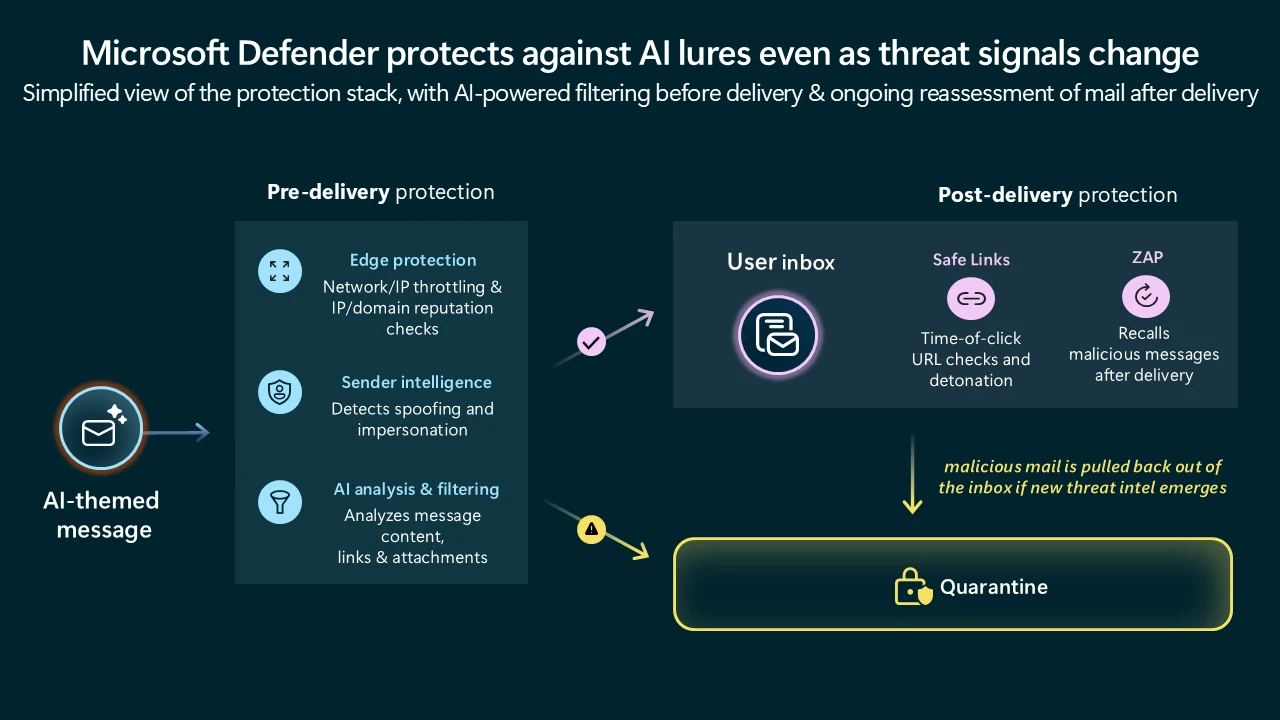
In practice, protection starts before the user ever engages with the lure. Microsoft Defender’s anti-phishing policies can help detect spoofing and impersonation attempts, including user and domain impersonation, first-contact messages, mailbox intelligence signals, and other suspicious sender characteristics. For an AI-themed lure, that might look like a fake “Copilot policy update,” a spoofed support notice, or a lookalike domain designed to make a credential collection page feel legitimate.
If the campaign relies on links, Defender’s Safe Links provides URL scanning and detonation during mail flow, plus time-of-click verification when a user selects a link in email, Microsoft Teams, or supported Microsoft 365 apps. That is important when cyberattackers use redirect chains, delayed activation, or links that appear benign at delivery but later resolve to phishing infrastructure, fake sign-in pages, or malicious downloads.
For campaigns that use fake installers, malicious downloads, or weaponized attachments, Safe Attachments adds another layer by detonating attachments in a virtual environment before delivery when policies are configured. For example, if a message promotes a “new AI plugin” but includes a harmful attachment, Safe Attachments can analyze the file for malware, ransomware, or phishing behavior before it reaches the user. If a cyberthreat is identified after delivery, Defender’s post-delivery filtering capabilities help remove malicious content from mailboxes and reduce the window of exposure.
Protect against multi-stage attacks with attack disruption
But AI-powered attacks don’t stop at email. Their objective is to gain the highest level of access possible, using compromised accounts as a foothold to move across identities, devices, and data. When a cyberattack moves beyond the inbox, Defender helps connect the evidence. Signals from email and collaboration tools, endpoints, identities, and software as a service (SaaS) apps are correlated into an attack story so analysts can see whether the same lure led to a clicked link, a downloaded payload, risky sign-in behavior, or endpoint activity.
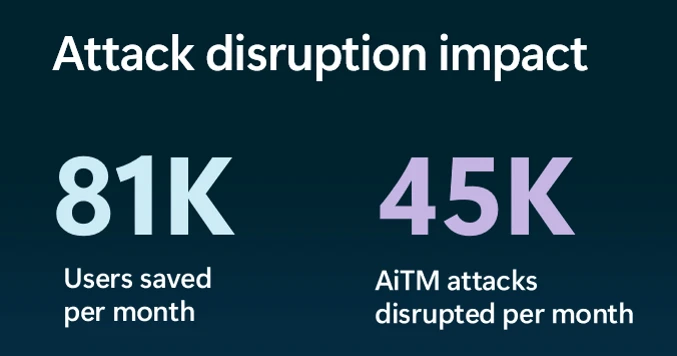
As cyberattackers expand beyond email to gain broader access across the environment, Defender moves from detection to disruption. For multi-stage, multi-domain attacks like business email compromise or AiTM, Defender’s powerful, built-in response capability, attack disruption, will contain the compromised asset during the attack to prevent further lateral movement while security teams investigate and remediate. Attack disruption contains more than 81,000 compromised user accounts monthly and is now disrupting more than 45,000 AiTM attacks each month.
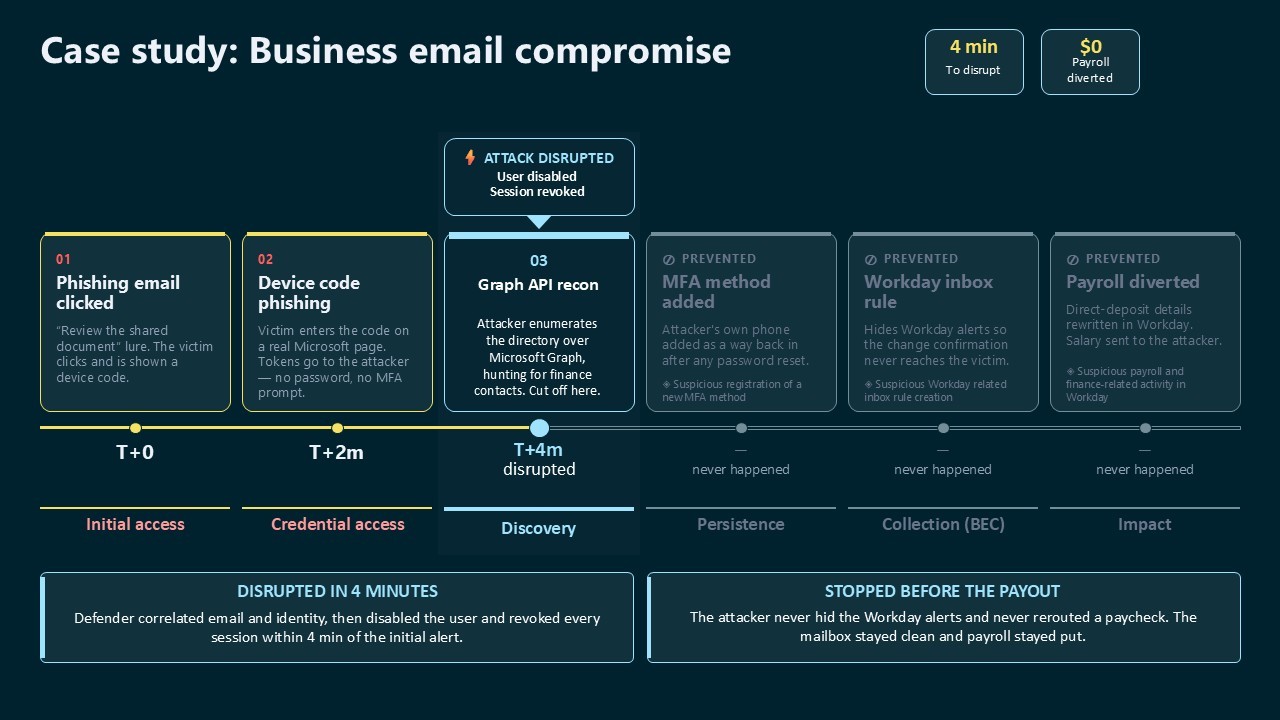
In a recent case study, Defender disrupted a business email compromise attack within four minutes of the initial activity (Figure 4). While response times may vary by scenario, this case shows the impact of attack disruption on a real cyberthreat. The cyberattacker used a convincing document-sharing lure to trick a user to start a legitimate Microsoft device code sign-in flow, which avoided traditional credential theft techniques. Defender recognized the resulting device code authentication and follow-on activity as suspicious, correlated signals across identity and email telemetry, and disrupted the attack within four minutes before the attacker could establish persistence, create inbox rules, or execute payroll fraud.
The takeaway
AI brands are the new bait, but the underlying lesson is bigger than any single campaign. As cyberattackers continue to exploit the momentum around AI, organizations should expect social engineering to become more targeted, more believable, and more difficult to evaluate in isolation.
The answer is not to treat every new lure as a brand-new category of risk. It is to build a protection model that makes trust harder to exploit across the full attack chain. Microsoft Defender helps organizations do that by connecting prevention, detection, investigation, and response across the attack path, so AI-themed lures are harder to deliver, harder to trust, and harder to turn into broader compromise.
To learn more about Microsoft Security solutions, visit our website. Bookmark the Security blog to keep up with our expert coverage on security matters. Also, follow us on LinkedIn (Microsoft Security) and X (@MSFTSecurity) for the latest news and updates on cybersecurity.
1AI brands as bait: How threat actors are using the AI hype in social engineering, Microsoft Threat Intelligence. June 8, 2026.