Every benchmark tells a story. The most valuable ones tell us where to improve next.
For five consecutive quarters Microsoft has published email security benchmarking reports to provide greater transparency into real-world protection outcomes. The results have shown strong Microsoft Defender performance across pre-delivery and post-delivery scenarios, while revealing where threats and defenses continue to evolve.
This quarter’s benchmark examines how continuous measurement informs protection across prevention, detection, and adaptation, and how those insights are helping improve customer outcomes.
Key takeaways
- Defender again missed the fewest high-severity threats among the solutions evaluated, about 55% fewer than the next-closest secure email gateway (SEG) vendor.
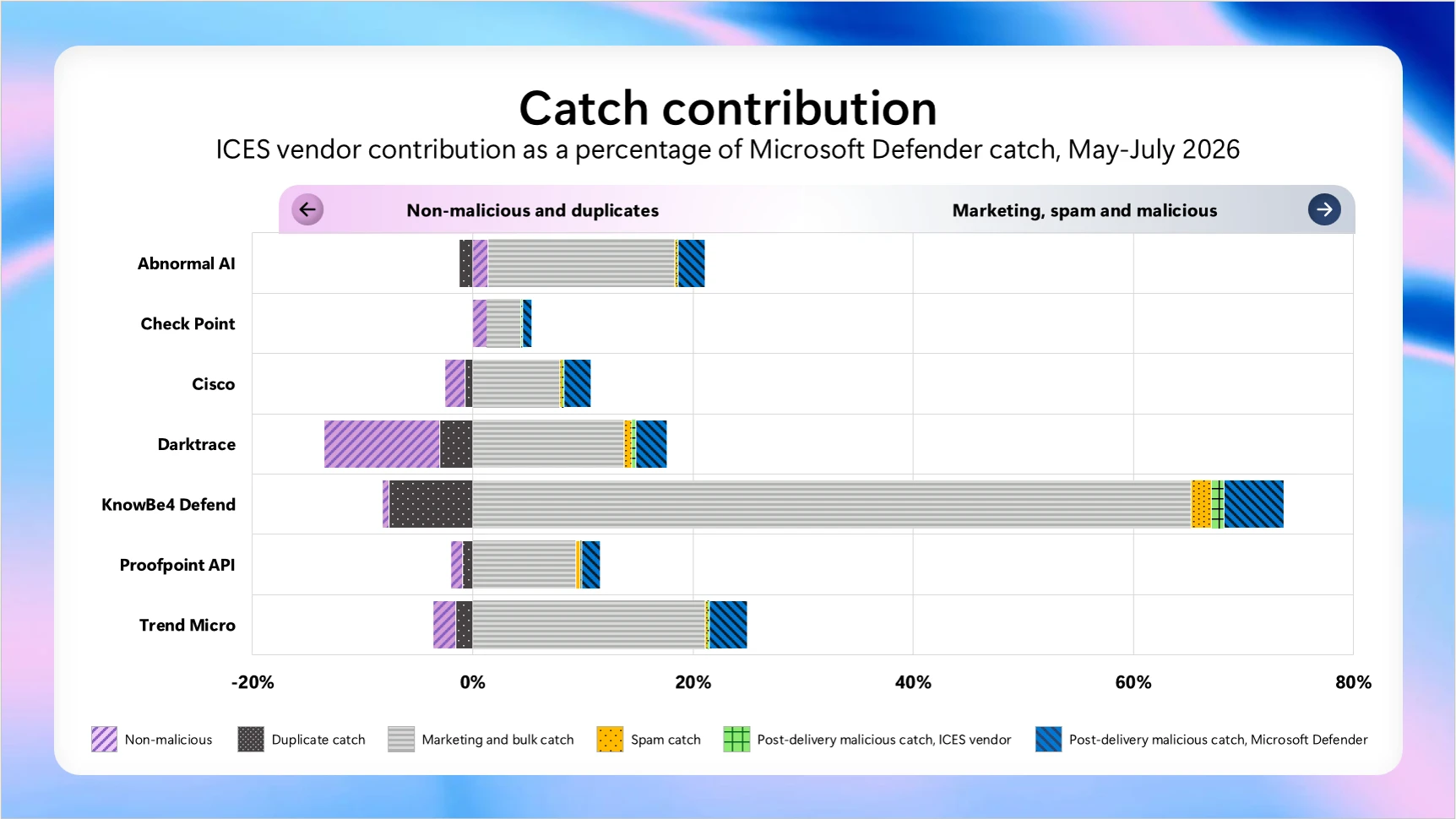
- Layered security adds the most value in promotional and bulk filtering and works; gains for spam and malicious email remain comparatively modest.
Benchmarking results for SEG vendors
In the latest quarterly SEG comparison from May 2026 through July 2026, Defender missed 221 high-severity threats per 1,000 protected users, 55.4% fewer than the next-closest SEG vendor. The benchmark measures missed threats instead of the total number of malicious emails that were caught and filtered, because catch totals can reflect differences in threat volume and exposure across vendor environments. By normalizing missed threats per 1,000 users we are able to provide a more consistent side-by-side comparison.
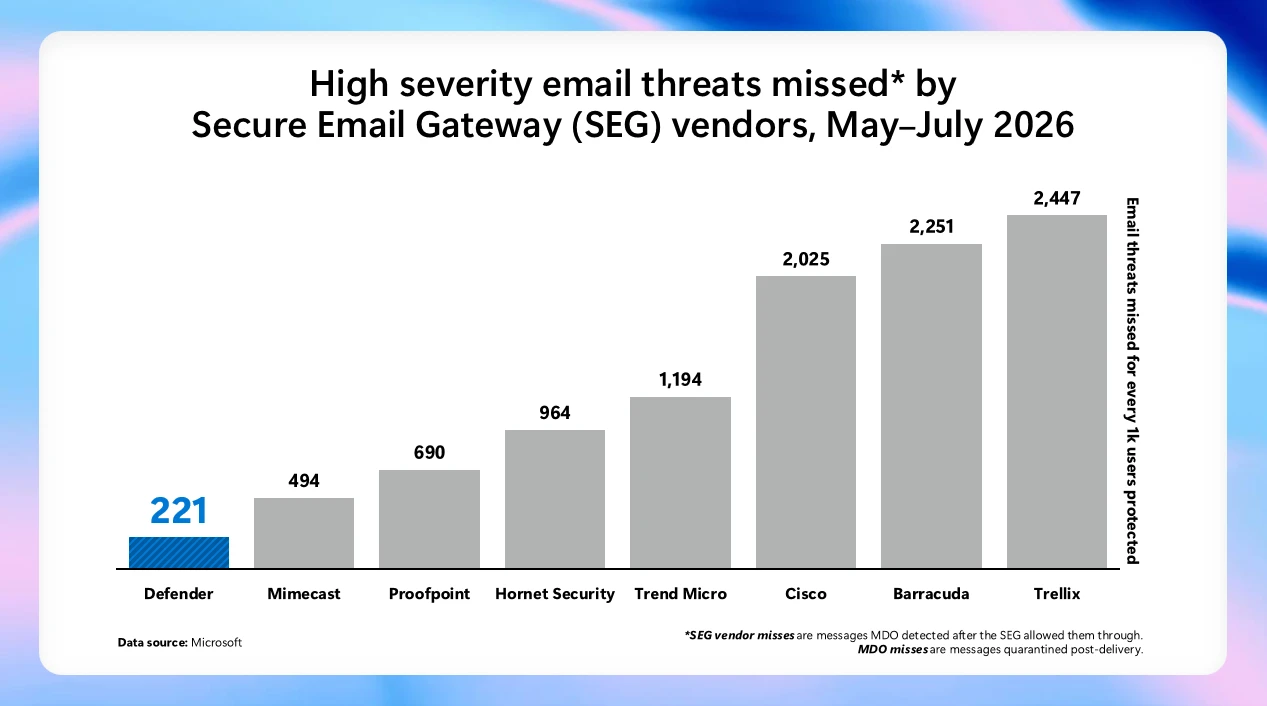
If you’ve read our previous blogs, you’ll see that missed threats have increased across multiple reporting periods, including for Microsoft. This aligns with broader trends we’re seeing as AI makes it easier for cyberattackers to gather public information, tailor messages, and create more convincing impersonation attempts. It reinforces the need for protection that continuously adapts.
Benchmarking results for ICES vendors
Effective email detection combines pre-delivery filtering with post-delivery detection and remediation. This benchmark helps customers evaluate where each layer contributes measurable value.
Similarly to previous quarters, integrated cloud email security (ICES) solutions continue adding the most value in promotional and bulk filtering. We saw an improvement in ICES vendor malicious catch at 0.30% versus 0.13% in the last quarter and spam catch going up to 0.52% versus 0.28% compared to last quarter.
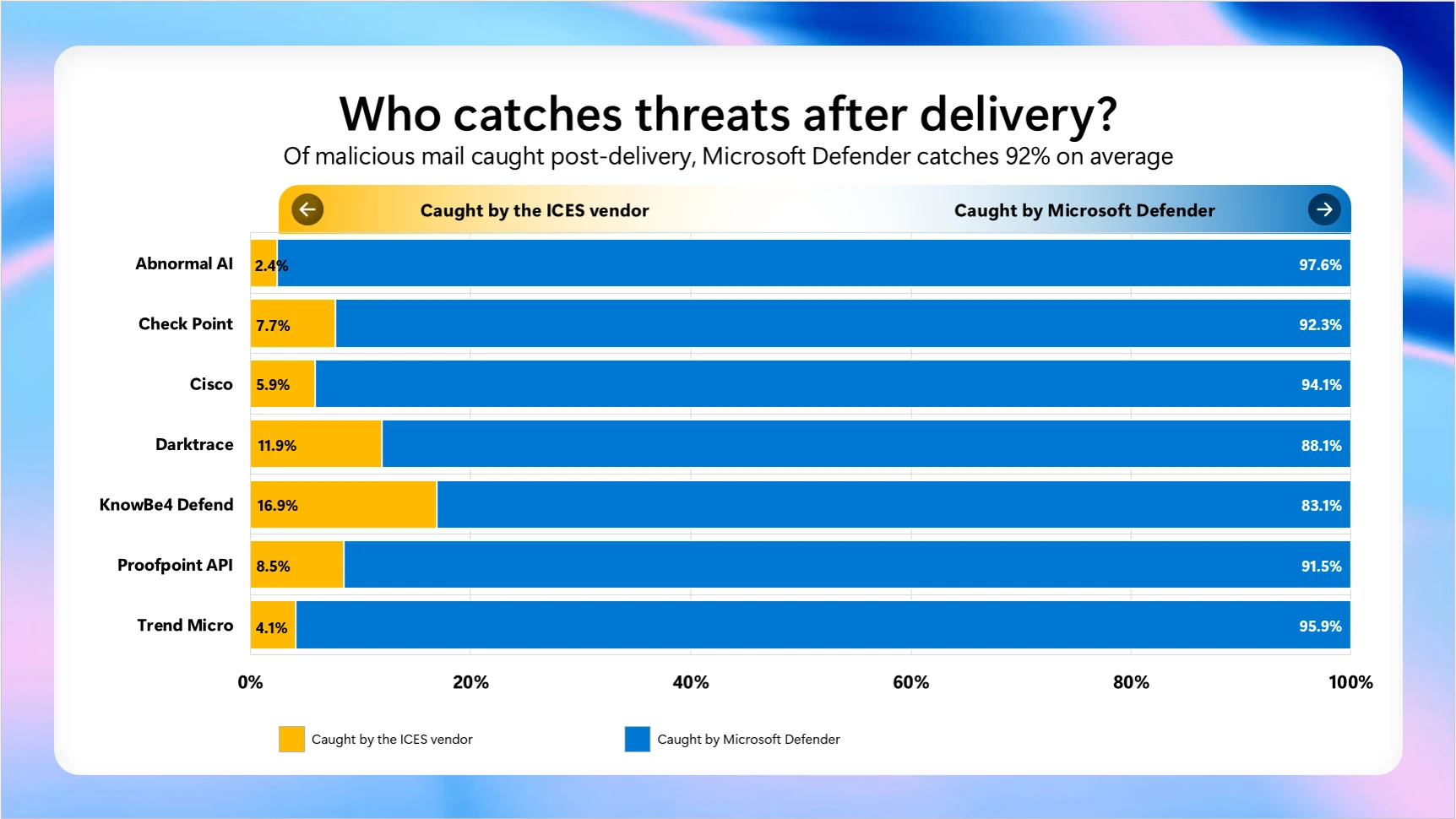
Defender caught 92% of post-delivery malicious messages on average during the benchmark period, highlighting how the combination of pre-delivery and post-delivery remediation delivers strong results for customers.
At the same time it’s key to understand that Defender doesn’t treat post-delivery remediation as a point-in-time action after the email was first delivered to the inbox. Even after a message reaches the inbox, new threat intelligence can reveal risks that were not apparent at the time of delivery. Defender continuously reevaluates delivered messages and remediates threats as new indicators, campaign intelligence, and threat signals emerge.
How our benchmarking is helping shape product innovation
The value of benchmarking is what happens after measurement. Insights from customer feedback, threat telemetry, and benchmarking have informed recent Microsoft Defender investments:
- More control over promotional mail: Across multiple benchmarking periods, we observed that ICES solutions often delivered the greatest incremental benefit in filtering promotional and bulk email. The new Promotions folder in Outlook builds on these insights by helping users reduce inbox clutter while keeping legitimate marketing and bulk messages accessible.
- Redesigned machine learning and AI model stack: By analyzing and incorporating natural language processing signals, including message topic, alongside other AI detection signals, Defender can improve detection accuracy. During a consecutive four-week period, Microsoft research observed a roughly two-thirds reduction in false negatives and a nearly one-fifth reduction in false positives for Defender customers.
- Protection for people and AI: We built prompt injection protection to detect and isolate malicious AI instructions in email before delivery—helping protect not only people, but also Copilot, agents, and other AI systems that read and act on inbox content. This innovation demonstrates how we continue evolving our defenses to address the latest cyberattack techniques and stay ahead of emerging threats.
Looking ahead
Since July 2025, our goal has been to bring greater transparency to email security effectiveness. Today, we are using benchmarking to help customers understand how cyberthreats evolve, where defenses add value, and how protection improves over time.
Benchmarking is not simply about demonstrating effectiveness, it is about learning from real-world outcomes and translating those insights into stronger protection. As cyberattackers continue to innovate, we remain committed to sharing evidence, improving our technology, and helping customers stay ahead of emerging cyberthreats.
To explore the latest benchmarking data and learn more about how Defender and ICES partners work together, access the benchmarking site.
Learn more
Learn more about Microsoft Defender.
To learn more about Microsoft Security solutions, visit our website. Bookmark the Security blog to keep up with our expert coverage on security matters. Also, follow us on LinkedIn (Microsoft Security) and X (@MSFTSecurity) for the latest news and updates on cybersecurity.