
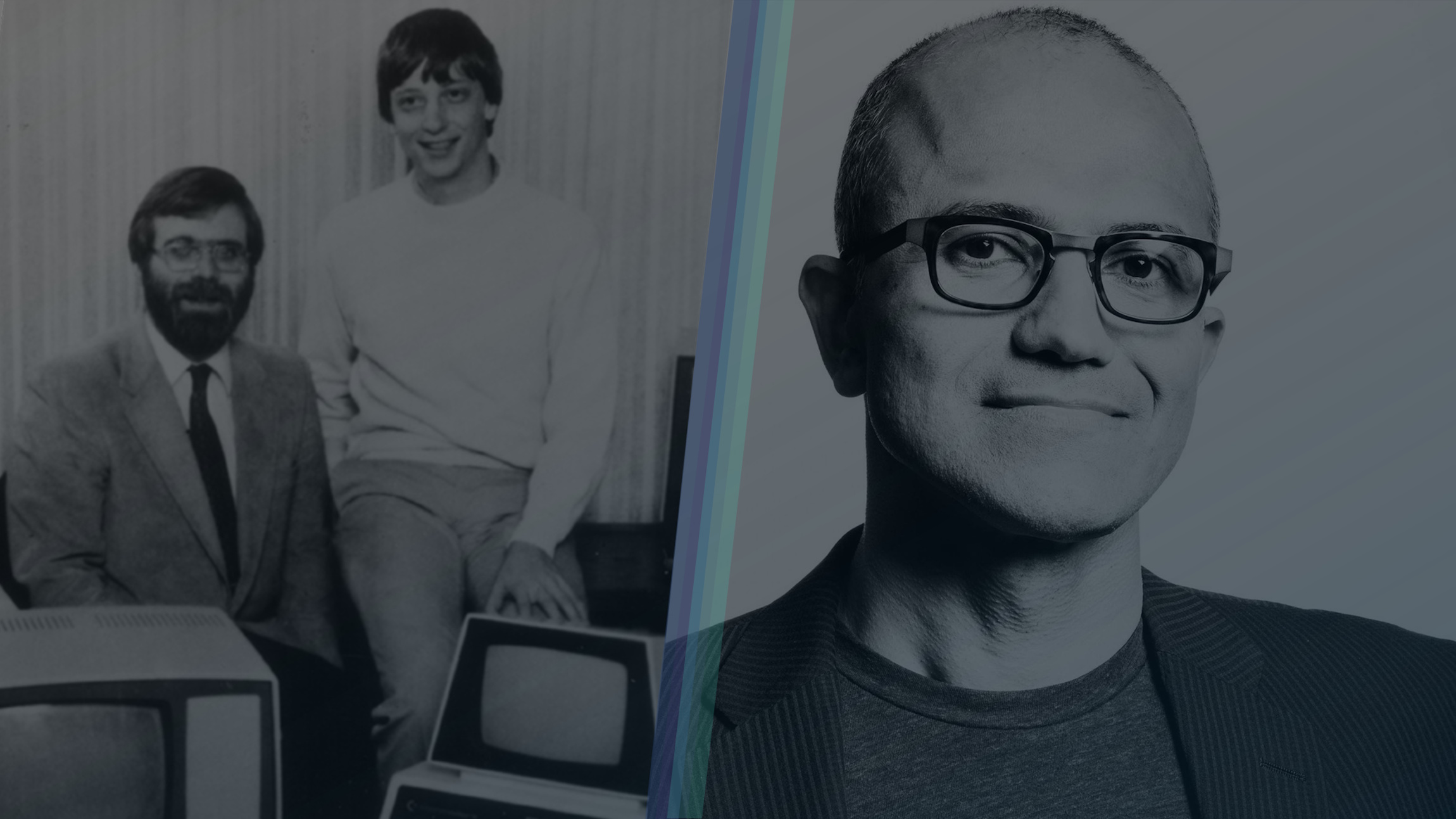
The digital transformation of Microsoft spans the entire personal computing revolution, from the days of DOS and early Windows desktops, through our journey to the Azure cloud and into the era of AI and agents.
Today, the company has grown into a global organization with more than 200,000 employees. They all rely on Microsoft Digital—the company’s IT organization—to provide the tools, technologies, and solutions that empower them to accomplish more every day.
The need for digital transformation
The history of information technology is one of constant evolution, and the pace of change has never felt greater than it does right now. The AI capabilities and other groundbreaking innovations unveiled in the last few years show the potential to radically transform our world and change the way we think about and operate all IT services.
When the world pivoted to remote online work and collaboration because of the COVID-19 pandemic, it was just one example of how digital transformation doesn’t always happen in a straight line or on a predictable schedule. Our company’s history of shaping and adapting its IT organization to the latest challenges faced by employees and partners is no different; marked by big bets and strategic shifts that reflect our ever-changing world.
Mapping our IT journey

Today, Microsoft Digital is the team that powers, protects, and transforms the digital employee experience across all devices, applications, and hybrid infrastructure at the company. Using our deep knowledge and experience in enterprise IT, we’re pivoting to help lead the company’s AI transformation while also sharing our journey with customers so they can take advantage of this generational opportunity to reshape their businesses and IT operations.
To understand where we’re going, it helps to take a look at where we’ve been. This article explores the details of the major eras of our IT history and then shifts to examine the trendlines and technological innovations that are shaping Microsoft now.
On-Premises IT (founding to 2009)
It’s useful to break the history of our IT operations into different eras. For the first three decades or so from its founding in 1975, Microsoft operated with on-premises IT systems. This era was characterized by the setup, operation, and maintenance of onsite physical technology—servers, datacenters, and other hardware infrastructure.
During this time, IT roles were narrowly defined. IT team members functioned primarily as “order-takers,” with limited influence over strategic decisions.
Because funding was inconsistent, our IT organization had limited growth opportunities and relied on vendors for development work. Gaps were filled in with “shadow IT,” where internal teams would sometimes procure their own hardware or software without formal IT approval or standards.
We established security as an early priority for the company. Cofounder Bill Gates launched the Trustworthy Computing initiative more than two decades ago, an effort emphasizing the importance of security, privacy, and reliability across Microsoft products and services both internally and externally.
Our On-Premises IT era established the foundation that would become crucial to the company’s future digital transformation.
All in on the cloud: The Cloud and Culture era (2010-2018)

Cloud computing marked the next significant shift in the history of IT at Microsoft. It began in 2010 under the leadership of CEO Steve Ballmer, signaling a major break with the previous era of physical IT infrastructure and an important step toward today’s distributed-computing world.
The launch of the cloud computing platform then known as Windows Azure heralded this new era, as we transitioned away from an IT philosophy focused on the Windows desktop client toward a more platform-agnostic view. Cloud computing offered extensive advantages for customers and for our own IT environment, in terms of cost, performance, security, and scalability.
We started our journey by moving productivity workloads (Exchange and SharePoint) to the cloud. Then, we shifted new development to Azure and optimized modern applications to run in the cloud. We also moved existing applications targeted for migration to virtual machines. Today, more than 98% of our IT workloads run on Azure.
Cultural transformation
Another important shift during this era was the profound cultural transformation at Microsoft sparked by new CEO Satya Nadella, who rose to the top job at the company in 2014. Nadella had previously run the Microsoft cloud computing and enterprise group, so he was already steeped in the idea of transformational change at the company.

“Achieving our mission requires us to evolve our culture. It all starts with a growth mindset—a passion to learn and bring our best every day to make a bigger difference in the world.”
Satya Nadella, CEO, Microsoft
Before Nadella’s ascension, Microsoft had long been known for its extremely competitive, “know-it-all” culture. Employees succeeded by showcasing their own individual achievements and how their accomplishments exceeded their peers.
Nadella changed this ethos by championing a growth mindset, encouraging employees to be “learn-it-alls” rather than “know-it-alls.” The shift included placing new importance on how employees contributed to the success of others, a value that was incorporated into individual performance reviews. Nadella made this transformation his personal mission and directed leadership to propagate the new philosophy at all levels across the organization.
“Achieving our mission requires us to evolve our culture,” Nadella says. “It all starts with a growth mindset—a passion to learn and bring our best every day to make a bigger difference in the world.”
The combination of the shift to cloud computing infrastructure and overhauling the company culture helped set the stage for the major technological innovations to come.
A new vision: The Modern Engineering era (2018-2023)
For years, IT at Microsoft had been order takers, doing what the business requested with limited ability to impact strategic priorities. That changed as we shifted to become a modern engineering organization. With support from our executive leadership, IT was elevated to become a peer engineering function at Microsoft.
Rather than simply taking orders, the team was empowered to lead with a strong vision for the future. In fact, leading with vision is the primary hallmark of our Modern Engineering era. As we moved into this era, we needed a clearly articulated view of our goals as an IT organization aligned to the needs of our business partners, as well as the resources needed to achieve them.
Role transformation
Transitioning to become a modern engineering organization required Microsoft Digital to adapt our legacy approach to IT.
Operating an engineering organization in a cloud environment meant new roles, new skills, and a new mindset. With no need to manage physical hardware, our modern IT professionals were freed to work more closely with business partners, requiring greater strategic acumen. The team was now focused on DevOps, Agile program management, and user-centric design principles.
User-centric, coherent design
Our design philosophy puts the user—an employee or guest—at the heart of every decision we make at Microsoft Digital.
The goal of this approach is to make tasks that might have previously caused friction to become simpler. Instead of dealing with disconnected systems, user-centric design introduces consistent and logical flow between services. This makes it easier for people to access services, learn how to use them, and then put them to good use.
Microsoft also embraces coherent design across all our products. A familiar look and feel, along with consistent usage patterns, accelerates employee usage and adoption.
Embracing work-from-anywhere capability
During the pandemic, when our workforce was still fully remote, our organization was already starting to think about what the new hybrid workplace would look like when people started returning to the office. We identified three key dimensions of the employee experience:
- Physical spaces: We partner with Global Workplace Services to plan and deploy meeting spaces with amazing digital capabilities that support an inclusive approach to hybrid productivity.
- Digital capabilities: We keep employees productive and their digital environment safe and secure, no matter where they’re located or how they connect.
- Culture: A strong partnership with HR ensures that digital experiences support our company culture.
Managing shadow IT with a culture of trust
Shadow IT is the unknown and unmanaged set of applications, services, and infrastructure that are developed and managed outside standard IT policies. Shadow IT typically crops up when engineering teams are unable to support the needs of non-engineering partners, a situation that could arise from a lack of available capacity or the need for specialized domain solutions.
While earlier eras of our IT history focused on trying to prevent shadow IT, we are now concentrating on managing it. We use Azure best practices to optimize shadow IT and Microsoft 365 governance policies to ensure that our corporate security, privacy, and accessibility standards are met. We empower our employees to create whatever they need within our tenant, including PowerApps, SharePoint sites, Teams channels, or agents, mitigating the need for “shadow” solutions while also providing visibility into how our employees are using our own technology.
Learn how optimizing our Microsoft Azure usage is helping us manage our Shadow IT.
The Era of AI (2023 to present)
The latest chapter in the history of our organization’s digital transformation is defined by the integration of AI and agents into IT operations. AI is revolutionizing how Microsoft does IT at enterprise scale, driving efficiency and innovation across the board. From the apps, workflows, and services that power our employee experience to the network, infrastructure, and devices that enable employee productivity, our AI-focused investments provide a solid foundation for the innovations that we are constantly implementing. As we look at the future of Microsoft Digital, we’re focused on four key priorities: security, service fundamentals, acting as Customer Zero, and AI-powered innovation. We’re working to excel in all four domains with the help of our industry-leading AI capabilities.

“Our mission is to power and protect Microsoft, and that starts with an unwavering commitment to the Secure Future Initiative.”
Brian Fielder, vice president, Microsoft Digital
Securing our future
Security is our highest priority. The Microsoft Secure Future Initiative aligns every team with a shared approach, common priorities, and consistent milestones to harden our security posture across all products and services.
“Prioritizing security above all else is critical to our company’s future,” Nadella says. “Every task we take on—from a line of code to a customer or partner process—is an opportunity to help bolster our own security and that of our entire ecosystem. If you’re faced with a tradeoff between security and another priority, your answer is clear: Do security.”
The Secure Future Initiative is built on three core principles: Secure by design, secure by default, and secure operations. As the company’s IT organization, we work relentlessly to fulfill the key pillars of the Secure Future initiative across all our systems, including:
- Safeguarding identities and secrets
- Protecting tenants and isolating production systems
- Securing networks and engineering systems
- Enhancing threat detection
- Expediting response and remediation
“Our mission is to power and protect Microsoft, and that starts with an unwavering commitment to the Secure Future Initiative,” says Brian Fielder, vice president of Microsoft Digital.
Secure Future Initiative | Microsoft
Foundations: Service fundamentals
The second pillar is to maintain the highest standards of service fundamentals. These are the essential capabilities and practices that enable us to deliver reliable, secure, and compliant services companywide. Adhering to the highest standards of service fundamentals ensures that our organization continues to play a critical role in running the company’s business and enabling innovation, agility, and resilience in a fast-changing and competitive environment.
Customer Zero
The third pillar is acting as Customer Zero for Microsoft’s most important products and services, like Copilot Studio, Microsoft Teams, and Agent 365. In Microsoft Digital, we take pride in being the first customer for a wide variety of Microsoft products and services, relentlessly focusing on our own employee experience to create products that enable every person on the planet to achieve more.
Being Customer Zero means forging a deep partnership between our IT organization and product engineering groups to envision the right experiences, co-develop innovative solutions, and then listen to and act on insights gathered from our employees. We work together to stay grounded in the way our employees use our products every day, so your employees can benefit from our insights prior to external product launches.
Read about how we’re improving our employee experience through our Customer Zero focus.
AI-powered innovation
The final pillar of this era is innovating with AI to transform the digital experience at Microsoft. By doing all the fundamental work detailed above—security, foundations, and Customer Zero—extremely well, we gain the confidence and earn the trust necessary to embed AI across our full portfolio of services. We do this over three key dimensions: core IT services, employee experiences, and corporate functions.
Core IT services: Transforming and securing our network and infrastructure
We’re focused on using AI to infuse data-driven intelligence into every part of our infrastructure and network operations. This allows us to optimize operations and increase security while simultaneously improving outcomes.
Examples include:
- Network observability and governance: Ensuring data accuracy, eliminating non-compliant hardware and software, and real-time updates
- Securing endpoints: Device management, asset management, and patching
- Zero Trust networking: Isolating device classes and limiting attacker’s movements across the network
- Network access: Azure VPN, identity management, and Secure Access Workstation (SAW) infrastructure security
Learn how we’re transforming our enterprise IT operations at Microsoft.
Core IT services: Tenant management
We manage one of the most complex tenants anywhere. Governance today is a somewhat fragmented experience, with no clear mechanism for IT to safely enable self-service asset creation for sites, Teams, groups, Power Apps, and so on. These unmanaged assets increase the risk of over-sharing sensitive data and compromise the health and security of our IT environment.
In the world of AI, security through obscurity is no longer a viable option. This means data hygiene, permission management, and data protection are essential to providing trustworthy AI tools that don’t overexpose sensitive content, while still providing quality responses.
Read about one way we’re improving security by protecting elevated-privilege accounts at Microsoft.
Core IT services: Support
We’re using generative AI to transform the way our employees interact with our support services. IT issues will be either auto-remediated or resolved remotely and instantly through conversational, personalized, and contextualized solutions, often without a human agent’s intervention.
We’ll accomplish this with a focus on the following:
- User experience: Our employees are using the AI-powered Employee Self-Service Agent to access personalized, accurate, and cost-effective issue resolution. Future goals include implementing a seamless transition to a human agent while the user stays within the agentic Copilot experience.
- Human agent experience: Operational efficiency and automation are being integrated into the Service Operations Workspace. The service includes chat and incident summarization that recommends best next actions and drafts contextual answers to queries.
Find out how we’re transforming IT support at Microsoft with AI and the Employee Self-Service Agent.
Defragmenting the employee experience
The second dimension where we’re implementing our AI vision to make a difference is our employee experience. Our vision is to deliver a unified, connected, and personalized experience where users can access employee data, tools, and insights from one place.

“We see AI as the key to unlocking the full potential of our employees, delivering personalized experiences that empower us to work smarter, faster, and happier—unleashing the innovation and collaboration necessary for our success.”
Vijaya Alaparthi, principal group product manager, Microsoft Digital
One of the key ways we’re doing this is with Microsoft 365 Copilot, which functions as a “UI for AI” across our employee tools and services. An example is our Employee Self-Service Agent, an AI-driven tool based on Copilot that helps employees more efficiently find context-specific answers to their questions using natural language queries.
“We see AI as the key to unlocking the full potential of our employees, delivering personalized experiences that empower us to work smarter, faster, and happier—unleashing the innovation and collaboration necessary for our success,” says Vijaya Alaparthi, a principal group product manager in Microsoft Digital.
To achieve our vision, we’re building a workplace where AI defragments the employee experience by:
- Providing contextual support in the flow of work
- Reducing the number of sites and apps an employee must remember
- Using Microsoft 365 Copilot as the “UI for AI,” making it simple for employees to find information, take action, and even fully automate certain repeatable tasks
Corporate functions growth
Our third major priority in Microsoft Digital is to improve how we support the company’s corporate functions organizations, including legal and real estate and facilities.

“With AI, we have so many new ways to innovate. From optimizing building occupancy, to streamlining commute services, to automating contract and document management, we have incredible potential to make our corporate functions more efficient and impactful.”
Becky West, principal group product manager, Microsoft Digital
This is a particular challenge, as these teams are being asked to do more with less today; Microsoft can no longer afford to grow operational costs at the same rate as in the past.
AI is playing a fundamental role in transforming the business workflows of our corporate functions partners while improving operational efficiency, user productivity, regulatory and corporate compliance, and data-driven decision making. It’s revolutionizing the way they operate by automating repetitive and time-consuming operational tasks.
“With AI, we have so many new ways to innovate,” says Becky West, a principal group product manager in Microsoft Digital. “From optimizing building occupancy, to streamlining commute services, to automating contract and document management, we have incredible potential to make our corporate functions more efficient and impactful.”
Some of the corporate functions taking advantage of AI capabilities and related increased efficiencies include:
- Real estate and facilities: In supporting the technology needs for more than 500 company buildings worldwide, we are poised to use AI and related innovations to implement cost savings in the areas of workspace systems, facilities management, and space management.
Find out how we’re transforming facility operations at Microsoft with AI maps.
- Travel and expense: Our plan is to work for near-elimination of the traditional expense reporting process through AI-based and touchless experiences, driving simplification and productivity gains.
Check out how OneExpense transformed our employee expense reporting.
- Legal: Our vision for integrating AI into Corporate, External, and Legal Affairs (CELA) includes more discoverable legal findings, better corporate document management with the Docufy platform, enhanced engagement with Microsoft Philanthropies, and accelerated support for business-critical functions such as immigration, contracting, and insider trading compliance.
Read how AI is revolutionizing the way we support corporate functions at Microsoft.
Agentic AI: Becoming a Frontier Firm
This era of AI in IT has quickly morphed into a world in which agents are having major impacts across the enterprise. Microsoft Digital plays a central role in helping the company embrace this change and transform into a Frontier Firm: an organization that has deeply embedded AI and agents into its operations, products, and culture
As a Frontier Firm, we go beyond simply adopting AI as a discrete tool or additional technology. We’re actively integrating intelligent systems, rich data platforms, and human knowledge into a unified operating model, where automation, decision making, and innovation combine to spark acceleration at scale. Agentic AI is a core enterprise capability for us, powering everything from employee productivity to customer experiences and strategic decisions.
As Microsoft progresses into this agentic AI future—where autonomous or semi-autonomous AI agents understand context, take actions, and collaborate alongside humans—Microsoft Digital has played a lead role in deploying these capabilities internally. We’ve led the early adoption of tools like Microsoft 365 Copilot, Azure AI services, and custom-built agents that help us automate repetitive tasks, surface insights, and orchestrate workflows across systems while enforcing strict governance policies. Examples include AI-powered agents that assist in IT service management, network monitoring, and enterprise knowledge retrieval, which allow employees to focus on higher-value work and maximize their individual impact.
As AI agents continue to grow in power and functionality and become more deeply integrated into the daily workflows of knowledge professionals, Microsoft IT will maintain our leadership role and operate at the bleeding edge of this technological revolution.
A catalyst for change and growth
Microsoft’s digital transformation is a story of evolutionary change, resilience, and adaptation across multiple eras of information technology. From our origins as a traditional IT organization to becoming a modern engineering organization focused on driving AI-powered innovation, we in Microsoft Digital remain a catalyst for change within the company and our industry.
With our insights born from customer and employee obsession, we’re committed to streamlining IT operations while prioritizing security, revolutionizing user services, and facilitating corporate functions growth and development. All with the overarching goal of making Microsoft employees everywhere more productive while showing our customers and partners what’s possible as we move forward together into the future of IT.
Key takeaways
Our IT digital transformation story offers valuable lessons for organizations in the midst of their own IT journey. They include:
- Be vision-led: A clear, articulated vision is crucial for driving transformation.
- Foster a growth mindset: Encourage continuous learning and adaptability among employees (“learn-it-all” culture).
- Invest in people: Upskill and reskill your workforce to keep pace with technological advancements and emphasize diversity of skills and experience.
- Insist on security: Prioritize security in all aspects of operations to safeguard data and maintain trust.
- Focus on collaboration and partnership: Create successful hybrid work environments to foster strong partnerships across functions.
- Seek continuous improvement: Learn from the past and use those lessons to shape the future.
- Embrace AI: Take advantage of AI tools and technologies to drive efficiency, innovation, and security.
Try it out
Related links
- See how we serve as Customer Zero for the company in the era of AI.
- Learn about our strategy for becoming an AI-first Frontier Firm.
- Check out our full guide to how we deploy agents internally at Microsoft.
- Read about how we’re transforming internal support with our Employee Self-Service Agent.
- Explore how we’re using AI to reinvent enterprise IT operations at Microsoft.
